
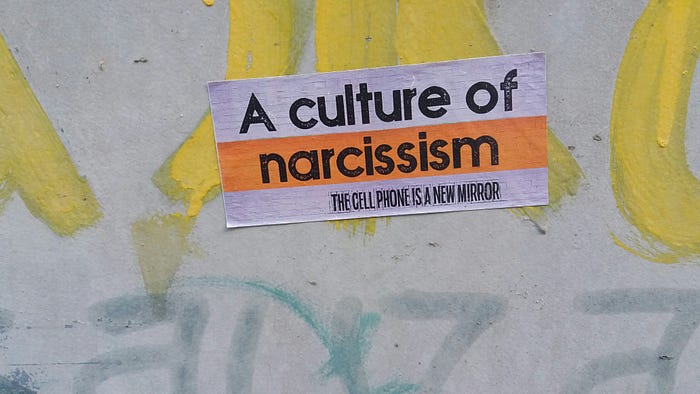



Have you ever know one of this?
Kaleidoscope, — Narcissistic traits are no longer unfamiliar to us, because narcissism is one of the human traits that we often encounter, and is also discussed on many platforms by various media.
We have to know this — Narcissism isn’t a forbidden trait. Each of us has potential to be narcissistic. However, we can always control narcissistic traits. The key is self-control. Consciously, we can truly control it.
Have you ever met one of them?
A narcissist is just someone who wants to stand on their own two feet. I want to convey that they are still human like the rest of us. However, there are certain types of narcissists who tend to have toxic habits. Toxic narcissists tend to drain others of their energy.
No, I’m not talking about NPD. NPD is too complex to discuss in this short article.
But let me share some typical signs that often appear in people with toxic narcissistic behavior —
I’ve met many people with narcissistic tendencies. Some of the people I’ve dealt with were completely unaware that they were toxic narcissists. I’ll underline this here, TOXIC.
Cause not all narcissists are toxic.
Okay, let me break it down here!

1. Excessive Sense of Superiority
Toxic narcissists tend to consider themselves the greatest, smartest, or most important without any real accomplishments. They often self-proclaim for small things they do. They may not have an impact or a big deal, but they consider them something to be proud of. They label themselves.
2. Thirsty for Praise and Admiration
Like Dracula’s logic, they are very thirsty people. They always need constant validation and praise from others. They always want attention and focus. If they are not validated, they will think others are evil. In fact, your own energy will be drained if you always respond to requests for validation from someone who has a toxic narcissistic attitude.
3. Fantasy of Success and Power
Yes, this isn’t just about fantasy. In fact, people with toxic narcissism can be truly obsessed with excessive fantasy. In their heads, a perfect life is a must. They are obsessed with fantasies of success, power, intelligence, or the perfect partner. If they don’t get any of these, or have the slightest weakness there, they will feel that their world is shaky. Like someone who is about to drown, sometimes they will do anything to force themselves to stay on the surface, even if they use someone else’s head as support.
4. Lack of Empathy
Because they are self-centered, they are unable or unwilling to understand the feelings, needs, and perspectives of others. If it’s about someone else, they will usually ignore or even belittle them. Often, they will pit their fate against yours or compare themselves to you. Instead of understanding, they will blame you if you don’t immediately stabilize your emotions when you try to share your suffering.
5. Entitlement
Yep, they feel like they’re the center of world civilization, I guess. They expect special treatment or automatic obedience from others. It’s a bit funny, I once met someone who did me a favor but they demanded excessive gratitude. When I said “thank you but it’s not necessary”, they forced me to accept it anyway. And when I later didn’t meet their expectations, they automatically turned me into a villain. It sounds unfair, but it exists!
6. Taking Advantage of Others (Exploitative)
They use or manipulate others to achieve personal goals. Yes, because they feel superior, they don’t care if what they do harms others. In their minds, manipulation is something that other people do regularly. They may think that other people also manipulate, so it is ‘halal’ for them because everyone else does the same thing.
7. Arrogant Attitude
They tend to display arrogance, feel superior, and like to belittle others. Condescension seems to be commonplace, because feelings of superiority surround people with toxic narcissism. So, it’s not unusual to hear them put others down, or boast about themselves. I’ve met people like this, they say “of course, my predictions never go wrong. I’m intuitive!” or “they definitely can’t, I’m the only one who can” – it’s tiring to hear, isn’t it?
8. Jealousy and Envy
They are easily envious of other people’s achievements, but believe that others are jealous of them. So, their logic seems to be unable to enter other people’s heads. Sometimes, when they feel that someone else is great, in their hearts they curse that person by feeling superior, “I can be better than him” is a typical statement of toxic narcissists. When someone else is superior to them, they will think that the person is actually jealous of them and trying to surpass them — Are you surprised? So am I.
9. Difficulty Accepting Criticism and Reluctant to Apologize
Tendency to be defensive, angry, or offended when criticized, even if it is constructive, is one of the typical traits of a toxic narcissist. For God’s sake, you must be wary of people who feel that the word sorry that comes out of their mouth is a sign of their inferiority. Because usually, the word of sorry is something they feel they don’t deserve to say. Why? They rarely feel guilty.
10. Dominance in Conversation
The most visible action is often monopolizing the conversation. Their ego is very strong, so they often talk about themselves excessively. In every good, high, and great thing, they will use various ways to show that they are important.
They want to be considered great and invincible. Still regarding overclaiming, they usually talk a lot about themselves. In conversation, they rarely give or listen to complaints. It could be that when it is your turn to talk, they will interrupt you with their perspective.
Why? Because they always want to be heard.
Research shows differences in brain structure, particularly in the areas that regulate emotion and empathy, such as the prefrontal cortex and limbic system. This makes it difficult for them to recognize others’ feelings, leading them to feel justified in positioning themselves above others.
One of the most influential studies was published in the Journal of Psychiatric Research. A team of researchers from the Charité – Universitätsmedizin Berlin found that people with narcissistic have a thinner volume of gray matter in the left anterior insula. This area is crucial for regulating emotional empathy and compassion responses.
Toxic narcissistic create a cycle of negative relationships where they position themselves above others and don’t hesitate to destroy the trust of those closest to them to maintain their self-image.
Behind their arrogant and superior exterior, they actually harbor very fragile self-esteem.
This sense of superiority is used to mask feelings of inferiority, fear of failure, or feelings of worthlessness buried deep within. ~

Melalui tulisan dan ilustrasi, saya menjelajahi labirin psikologi, kedalaman filsafat, dan estetika seni. Memeluk identitas sebagai philomath adalah cara saya berdaulat atas diri—sebuah manifesto bahwa ruang belajar terbesar adalah dunia, dan waktunya adalah selamanya

 Dewinta Ayuning Zulfa



 Hubaib Rohmatullah